Engineering 4all, Practical Engineering, Free Learning Source, By Photos You Can Learn What you are studying.
Pages
- Home
- Industrial Instrumentation
- Manuals Requests:
- DNA Testing
- What is Electrical Engineering?
- How Satellite TV Works?
- Website Hosting?
- What is cord blood?
- What is Data Recovery?
- Online Engineering Education
- General Electric Turbine
- Nature Photos
- Electrical Glossary
- Electrical Engineering Overview
- Electrical Courses and Lectures
- Valves
- Fundamental of Electricity 1
- Fundamentals Of Electricity 2
- Fundamentals Of Electricity 3
- Electrical Distribution Equipments Part A
- Electrical Distribution Equipments Part B
- Electric Motors Course
- ABB
Search For Electrical Stuff
Showing posts with label Switchgear. Show all posts
Friday, September 21, 2012
Saturday, August 4, 2012
Tuesday, July 31, 2012
Switchgear Components
Introduction
Switchgear is used to connect and disconnect electric power supplies and systems. It is a general term which covers the switching device and its combination with associated control, measuring, protective and regulating equipment, together with accessories, enclosures and supporting structures.
Switchgear is applied in electrical circuits and systems from low voltage, such as domestic 220/240V applications, right up to transmission networks up to 1100 kV.
A wide range of technology is needed, and this chapter is split into the four main subdivisions of low voltage, medium voltage (distribution), high voltage (transmission)
and dc.
The main classes of equipment are as follows:
● disconnectors, or isolators
● switches
● fuse–switch combinations
● circuit breakers
● earthing switches
A switch is a mechanical device which is able to make, carry and interrupt current occurring under normal conditions in a system, and to close a circuit safely, even if a fault is present. It must therefore be able to close satisfactorily carrying a peak current corresponding to the short-circuit fault level, and it must be able to carry this fault current for a specified period, usually one or three seconds.
A fuse and a switch can be used in combination with ratings chosen so that the fuse operates at currents in excess of the rated interrupting or breaking capacity of the switch.
A circuit breaker is a mechanical switching device which is not only able to make, carry and interrupt currents occurring in the system under normal conditions, but also to carry for a specified time and to make and interrupt currents arising in the system under defined abnormal conditions, such as short circuits. It experiences the most onerous of all the switching duties and is a key device in many switching and protection systems.
An earthing switch is a mechanical device for the earthing and short-circuiting of circuits. It is able to withstand currents for a specified time under abnormal conditions, but it is not required to carry normal service current. An earthing switch may also have a short-circuit making capacity.
Switchgear is used to connect and disconnect electric power supplies and systems. It is a general term which covers the switching device and its combination with associated control, measuring, protective and regulating equipment, together with accessories, enclosures and supporting structures.
Switchgear is applied in electrical circuits and systems from low voltage, such as domestic 220/240V applications, right up to transmission networks up to 1100 kV.
A wide range of technology is needed, and this chapter is split into the four main subdivisions of low voltage, medium voltage (distribution), high voltage (transmission)
and dc.
- Circuit breaker compartment
- Bus bar compartment
- Cable compartment
- Low voltage compartment
- Arc channel
- Current transformers
- Voltage transformers
- Earthing switch
The main classes of equipment are as follows:
● disconnectors, or isolators
● switches
● fuse–switch combinations
● circuit breakers
● earthing switches
A disconnector is a mechanical switching device which in the open position provides a safe working gap in the electrical system which withstands normal working system voltage and any overvoltages which may occur. It is able to open or close a circuit if a negligible current is switched, or if no significant change occurs in the voltage between the terminals of the poles. Currents can be carried for specified times in normal operation and under abnormal conditions.
High Voltage Disconnect Switch
A switch is a mechanical device which is able to make, carry and interrupt current occurring under normal conditions in a system, and to close a circuit safely, even if a fault is present. It must therefore be able to close satisfactorily carrying a peak current corresponding to the short-circuit fault level, and it must be able to carry this fault current for a specified period, usually one or three seconds.
A fuse and a switch can be used in combination with ratings chosen so that the fuse operates at currents in excess of the rated interrupting or breaking capacity of the switch.
Such a device is known as a ‘fuse switch’ if the fuseholder is also used as part of the main moving contact assembly, or a ‘switch fuse’ if the fuse is a separate and static part of an assembly which includes the switch connected in series.
Figure(1) shows schematically the various combinations of fuse, switch and disconnector that are available.
Main features of a fuse switch
A circuit breaker is a mechanical switching device which is not only able to make, carry and interrupt currents occurring in the system under normal conditions, but also to carry for a specified time and to make and interrupt currents arising in the system under defined abnormal conditions, such as short circuits. It experiences the most onerous of all the switching duties and is a key device in many switching and protection systems.
An earthing switch is a mechanical device for the earthing and short-circuiting of circuits. It is able to withstand currents for a specified time under abnormal conditions, but it is not required to carry normal service current. An earthing switch may also have a short-circuit making capacity.
AC high voltage earthing switches
Friday, July 27, 2012
Medium Voltage Switchgear
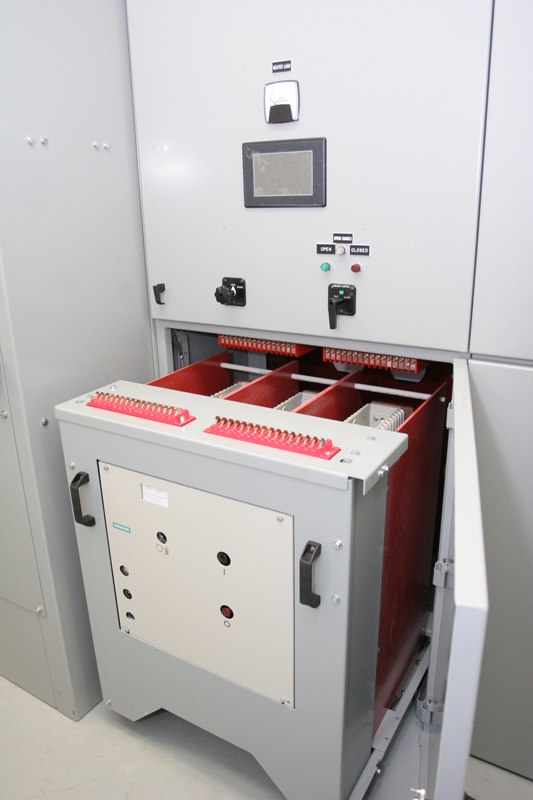
For medium-voltage systems, the metal-clad and metal-enclosed switchgear provide centralized circuit control. A complete line of functional units is available for control and protection of motors, transformers, generators, distribution lines, rectifiers, and similar power equipment. Each standard self-contained unit utilizes basic-world reliable components, including vacuum circuit breakers, magnetic blast breakers, instruments, relays, meters, instrument transformers, and control devices.
ABB's Unigear medium voltage switchgear
Low-voltage, metal-enclosed switchgear
Low-voltage, metal-enclosed switchgear are designed for the control and protection of power circuits of fans, pumps, lighting, and machines at 220 V, 240 V, 380 V, 480 V, or 600 V. These switchgear are adapted for power centers, such as central-station
auxiliary power circuits for fans, blowers, compressors, pumps, and lighting circuits; and industrial-plant power and lighting networks, power feeders, lighting feeders, power generation, and auxiliary power drives for machine tools and material-handling equipment.
Low voltage switchgear - Power distribution
(by MEC Electrical Engineering)
Thursday, July 26, 2012
SF6 Gas-Insulated Switchgear
Gas-insulated switchgear (GIS) has come to be a major piece of substation equipment. Over that period, GIS has been improved by technological advancements that have increased the interrupting capacity of the circuit breaker (CB) and decreased the number of breaks per single CB without using an air condenser.
The configuration of the GIS comes in several arrangements, such as the single bus, double bus, and ring-bus types. Because the arrangement is determined by a user’s specifications, we must create a different design each time.
Alstom 145kV Gas-insulated switchgear GIS
GIS offers high reliability, safety, and maintenance-free features in a much smaller space compared with conventional switchgear. The SF6 GIS guarantees outstanding advantages for the planning and operation of high-voltage supplynetworks. For instance, the space requirement can be less than 10% of the space taken up by an equivalent conventional installation.
As all live parts are metal enclosed and hermetically sealed, the SF6 GIS is completely immune to atmospheric pollution (fog, sand, salt, etc.) and industrial pollution (dust, smoke, gas, etc.). With SF6 GIS, all foreign bodies (persons, animals, and tools) are prevented from coming into contact with live parts. This ensures maximum safety to personnel and increased continuity of operation.
Main Features
- High reliability: The live parts are sealed in metal enclosures filled with pure SF6 gas. Thus, the switchgear is protected from contamination by smoke, chemical fumes, dust or salt-laden spray or by the ingress of small animals. This protection prevents the inside components from oxidation and rust caused by oxygen and moisture.
- Space reduction: A medium-voltage GIS can be installed into a space about half that required for conventional air-insulated metal-clad switchgear.
- High safety: All the live parts are fully enclosed in grounded metal enclosures. Thus, there is no danger of an electric shock. SF6 is an inert, nonflammable, nontoxic, and odorless gas used as an insulation and arc extinguishing medium. Therefore, it is safe for personnel and there is no fire hazard.
- Short installation time: A GIS of about four panels can be transported fully constructed. The GIS can be energized by connecting external power cables to the prefabricated plug-in type terminals, thus shortening installation time.
of line circuit of 550 kV GIS
Saturday, July 7, 2012
Friday, July 6, 2012
Thursday, July 5, 2012
Tuesday, July 3, 2012
Powell Electrical Metal-Clad Switchgear
Powell Electrical Manufacturing Company
Powl Vac Metal-Clad Switchgear
3000 Amp Main Buss
One 3000 Amp Circuit Breaker
Three 2000 Amp Circuit Breakers
15 KV Maximum Voltage
High Voltage Oil Padmount Switches 15 KV
High Voltage Oil Padmount Switches
High voltage oil padmount switches and substation switches
for use in electrical power distribution substations.
RTE Corporation: 321L30K60C
High Voltage Oil Padmount Switches 15.5 KV
High Voltage Oil Padmount Switches
High voltage oil padmount switches and substation switches
for use in electrical power distribution substations.
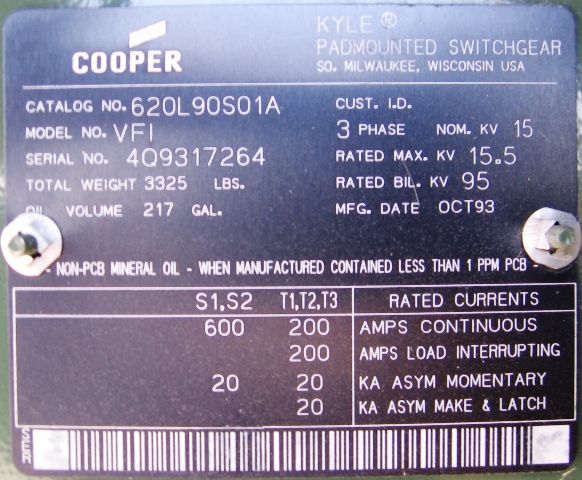
Cooper-Kyle:PST 6
High Voltage Oil Padmount Switches 15.5 KV
High Voltage Oil Padmount Switches
High voltage oil padmount switches and substation switches
for use in electrical power distribution substations.
Cooper-Kyle: VFI
Tuesday, November 8, 2011
Monday, November 7, 2011
Monday, July 11, 2011
Subscribe to:
Posts (Atom)